Feeds:
Posts
Comments

This is not a joke. Today in the faculty room I discovered the secret to science teaching success. There on the front page of The International Educator’s monthly newspaper was an article celebrating a school presentation of a science show called Brainiac Live! In the presentation (which is based on a British television show) a guy who goes by the name Dr. Bunhead (not a joke either) lights his head on fire to inspire students about the wonders of science. So there you have it- being a great science teacher is simple. All you need to do is blow things up, create giant ballons, shoot lightning bolts out of your fingertips, but most importantly- light your head on fire!

I hope you notice a slight hint of sarcasm here. It actually seemed highly ironic that this newspaper which celebrates best practices in education would be highlighting something that I consider worst practice. Don’t get my drift? Read on…

Science shows like these are intended to get students excited about science, right? And there’s no question that they’re exciting- who doesn’t want to watch Dr. Bunhead nearly sear his scalp?? But what exactly are the students getting excited about? As teachers we would hope they’re getting excited about scientific ideas, scientific thinking, in short- excited about learning more science. But that’s not the case- instead students are only focused on the awesome scientific phenomenon in front of them (in this case Bunhead’s flaming head). They’re excited about the explosions, the noise, the surprising result, but not about the scientific explanation that usually comes afterwards.

Using a show like this to inspire your students in science is kind of like coaching your high school basketball team by showing them the NBA slam dunk contest. Are they going to be excited? Sure! Inspired? You bet- they can’t wait to start practice the next day and spend an hour on… dribbling drills. NOT! In fact it could be argued that this approach to coaching or teaching could even be detrimental- because kids will come to expect the flash-boom-bang and never develop an appreciation for the less obvious excitements that take place inside one’s own head (as opposed to in a fiery ball above it).

Example: Last week my 4th grade students were super pumped when they discovered by themselves how to create an electromagnet with a set of materials I gave them without further instruction. The fact that their simple electromagnets were so weak they could only lift up a few metal washers did not dampen their excitement one bit- because it wasn’t the phenomenon they were focused on, but the idea they had come up with. Imagine if instead I had started the lesson with a wow me demonstration of electromagnets- say lifting up a car with a giant electromagnetic crane and letting it  come crashing down when I turned it off, and then follow that up with some lecture or reading about electromagnets or even a hands-on activity building a smaller model of the one I demonstrated. What would students remember a week later? Of course they could all recall in detail how Mr. Mitchell totaled a car, but very few of them would remember much of anything about the scientific explanation afterwards, or the version they made that paled in comparison. They’d be stuck on the awesome phenomenon, and the idea behind it would be merely a forgotten afterthought.

For all you literalists out there, I’m not advocating that demonstrations be banished from current teaching practice, I just think we need to be more thoughtful about how we use them and what they will cause students to think about. We need to go beyond “whoa!” and get to “why?”. Going back to my actual 4th grade electromagnets lesson (which I should say was based on the great FOSS unit Electricity and Magnetism), I did actually start out with a demonstration: I showed students a video clip of magician Jean Robert-Houdin’s famous “Light and Heavy Chest trick“. In the trick, Houdin secretly used a hidden electromagnet to attract the small chest to the floor so that a burly audience member couldn’t pick it up, then he turned off the electromagnet so it could be picked up easily by a child. After showing the video I didn’t try to explain the trick (that would get me kicked out of the Alliance!), instead I had students think about it themselves. As a class they were able to figure out that some sort of special magnet must be involved that could turn on and off- viola- electromagnets. I then told them they could use their knowledge about circuits to try and turn a steel rivet into a magnet that could be turned on and off, gave them the materials, and let them have at it. Using a demonstration in this way, as a teaser to introduce a problem/question/challenge, is in my opinion much more effective. (The parallels with narrative are striking- you would never start a story with a resolved climax, so why would you start your lesson with the most interesting part first?)

So go ahead and enjoy Dr. Bunhead’s pyrotechnics, just don’t expect this approach to inspire the next generation of scientists, or expect it to work well in the classroom. Students (and adults) are already amazed by fiery explosions, and a bunch of wow me science demonstrations are going to result in excitement about more fiery explosions, but not kindle much learning. Our real challenge as teachers is to figure out how to get students amazed by their own observations, their own thinking, to spark that fire in their mind- not on their head.

(Short disclaimer: I have not seen Dr. Bunhead’s particular science show, but I have seen others which I believe are very similar. Perhaps while Dr. Bunhead’s head burns down he also engage his large student audience in hands-on inquiry-based activities that inspire scientific thought and discovery… but I doubt it.)

After splurging on Christmas gifts for the family, I was in a thrifty mood when surfing Amazon to find some new reading material for the break. So I checked out the free options in the Kindle store for science education books. Unfortunately there’s not much out there besides a few textbooks and Ontario school manuals, but one gem I discovered was Science and Education by Thomas Henry Huxley. To save you the trouble of checking Wikipedia: Huxley was an English biologist in the 19th century and is known for being a fierce advocate of Darwin’s theory of evolution, earning him the nickname “Darwin’s Bulldog”. He also coined the term “agnostic” to describe his views on the existence of God, and thanks in part to his efforts science became part of the British school curriculum.

The book Science and Education is really a collection of orations and essays that he gave discussing the nature of the sciences, its relationship with culture and relation, and why science should be taught in schools. A lot of the speeches seem dated (there are some cringe-worthy lines about race and intelligence in particular), but two stand out: one entitled “On the educational value of the natural history sciences” (the full text is available here), and “Science education: notes of an after-dinner speech” (full text). In regards to science education they are both so spot-on they could have almost been written today. So what did a guy in 1854 have to say about science education before it was even introduced into the school system? Check out these quotes…

“Science is, I believe, nothing but trained and organised common sense, differing from the latter only as a veteran may differ from a raw recruit: and its methods differ from those of common sense only so far as the guardsman’s cut and thrust differ from the manner in which a savage wields his club….The man of science, in fact, simply uses with scrupulous exactness the methods which we all, habitually and at every moment, use carelessly”

Putting aside the “savage” metaphor, Huxley makes clear that the method of scientific thinking is nothing extraordinary, it employs the same critical thinking and logic people use on an everyday basis, it is only the discipline and training through repeated use that makes scientific thinking so effective. In other words- scientific thinking is innate to all of us and can be taught to anyone.

On the issue of whether young children can or should learn about about science:

“I doubt whether any toy would be so acceptable to young children as a vivarium of the same kind as, but of course on a smaller scale than, those admirable devices in the Zoological Gardens.”

As I have already said, a child seeks for information about matters of physical science as soon as it begins to talk.”

“And  if not snubbed and stunted by being told not to ask foolish questions, there is no limit to the intellectual craving of a young child; nor any bounds to the slow, but solid, accretion of knowledge and development of the thinking faculty in this way.”

As an elementary science educator, is always surprising that even today there are those who don’t understand the appropriateness of science education for young children. So many people forget how utterly instinctive a child’s curiosity and urge to investigate is. A science education that taps into these instincts and develops them into knowledge and skills is obviously appropriate (and necessary) at any level.

OK- so far so good Mr. Huxley, but what exactly should be taught? What do you 19th century guys know about standards and benchmark?

“I do not mean that every schoolboy should be taught everything in science. That would be a very absurd thing to conceive, and a very mischievous thing to attempt. What I mean is, that no boy nor girl should leave school without possessing a grasp of the general character of science, and without having been disciplined, more or less, in the methods of all sciences; so that, when turned into the world to make their own way, they shall be prepared to face scientific problems, not by knowing at once the conditions of every problem, or by being able at once to solve it; but by being familiar with the general current of scientific thought, and by being able to apply the methods of science in the proper way, when they have acquainted themselves with the conditions of the special problem.”

Touche. Huxley goes on to describe an ideal scientific curriculum that begins in elementary with studying the phenomena of Nature (kind of like combined Earth and Life sciences) to deal with questions of the observable world. Then as students writing, reading, and mathematics skills improves with age he advocates for “physical sciences” to be introduced, including experimental physics and fields of biology such as botany, with a dash of chemistry and human physiology. Not too shabby.

And what about pedagogy? Surely someone writing over 150 years ago had a very different perspective than our enlightened educational understanding today… right??

“If the great benefits of scientific training are sought, it is essential that such training should be real: that is to say, that the mind of the scholar should be brought into direct relation with fact, that he should not merely be told a thing, but made to see by the use of his own intellect and  ability that the thing is so and no otherwise.”

“But if scientific training is to yield its most eminent results, it must, I repeat, be made practical. That is to say, in explaining to a child the general phænomena of Nature, you must, as far as possible, give reality to your teaching by object-lessons; in teaching him botany, he must handle the plants and dissect the flowers for himself; in teaching him physics and chemistry, you must not be solicitous to fill him with information, but you must be careful that what he learns he knows of his own knowledge. Don’t be satisfied with telling him that a magnet attracts iron. Let him see that it does; let him feel the pull of the one upon the other for himself. And, especially, tell him that it is his duty to doubt until he is compelled, by the absolute authority of Nature, to believe that which is written in books.”

Thud! **Jaw hits the floor** This was the icing on the cake for me- Huxley, in 1869 mind you, is literally describing constructive learning theory and advocating for an inquiry-based approach to science education. And this is of course, before there even was such a thing as science education. It was even taught in schools yet, and Huxley himself was basically self-educated. Perhaps that’s why he could see the issue so clearly- his opinion was clouded by any educational traditions or assumptions. In fact the traditional education of the time consisted entirely of rote learning and memorization via books, so he was well aware of the limitations of this.

It’s clear that Huxley was a man ahead of his time, but also the fact that his words resonate so well today underscores just how self-evident this approach to science education is. Yes, we have a body of educational research today that confirms best-practices, and we’ve invented a whole language of educational jargon to go along with it, but if the best approach to science education was obvious to someone 150 years ago, then it should be pretty freakin’ clear to us by now! So the next time someone starts waxing on about today’s educational reforms in inquiry-based science, you just tell ’em about Darwin’s bulldog, who figured it out before science education even existed.

Over the holiday break I finally had a chance to read something that’s been sitting on my desktop for months: Lockhart’s Lament, an essay by the mathematician and teacher Paul Lockhart about the abysmal state of math education (he has also written a longer book version). If you haven’t read it, definitely check it out- it’s extremely thought-provoking and challenges a lot of assumptions about mathematics and education in general.

In his essay, Lockhart makes a lot of sweeping claims that may sound downright sacrilegious out of context: Standards? Get rid of them! Lesson plans? Planning to fail! Schools of education? A “crock”! But there’s a method to his madness, he makes a very convincing argument by cutting right to the quick of the debate: the point of math education itself. Lockhart rejects outright the common assumptions that students need to learn the standard math canon for use in everyday life (when’s the last time you used your school math skills to do something that required more than a calculator?), and he counters that advanced study should be relegated to the university level. In place of the standard math canon, he advocates for students learning by doing math as a mathematician would, puzzling things out for themselves and putting aside rote algorithms and standard notation for creative thinking and a sense of playfulness.

As a science teacher, I can’t speak to whether or not he’s right about math education (although you can read some interesting reactions from math folks here). But reading his essay did keep me coming back to science education to see if his criticisms also applied here… was science education in the same dire straits? My mind is still reeling from the implications, but here’s the first Lockhart-inspired thought I’ve been chewing on:

Scientific literacy: One of the fundamental assumptions of most science educators is that scientific knowledge is important whether or not students go on to work in a scientific field. The idea is that all people should have a certain level of “scientific literacy” so they can make informed decisions on issues that require some scientific understanding (think global warming, genetically modified food, vaccines, etc.). Lockhart argues (for math) that the current standard curriculum isn’t really adapted to this kind of purpose in the first case, and if we were serious about teaching students something useful for every day life it would require major changes. On that last point I have to agree with him in science as well- while I make an effort as a science teacher to show students how the subjects were learning apply to their real life, this idea of usefulness is obviously not the driving force, it’s more of an afterthought. What gives? Should the curriculum be changed to reflect the true importance of the goal of scientific literacy, or is it just weaker secondary justification for science education?

Interestingly enough, in a recent job interview I had for a Middle School science teacher position, a similar question came up: What’s the point of Middle School science education? I had already explained my belief that elementary science was all about establishing fundamental concepts and learning the skills of thinking like a scientist, and I had already conceded the truth that students don’t retain much factual knowledge from grade school anyway, so I had to stop and actually think during the interview (isn’t it funny how uncomfortable actual thinking on the spot is??). What I came down to was the idea that Middle School science would build on those elementary science fundamentals to teach students how science (and of course I also include in this the process of scientific thinking) really is useful and omnipresent in everyday life. After all, if every citizen had the equivalent of a good Middle School science understanding, we’d probably be in better shape than we are now, right?

So I can’t concede dismissing the value of scientific literacy, but I do agree that the standard science canon needs some serious reshaping in order to truly provide students with useful understanding for their everyday lives. Instead of teaching the subject first and then looking for applications afterward, why not start with the useful context and have that lead us to the necessary science? This reminds me a lot of the way Dan Myer approaches math problems: starting with the real-life context, and then having students add math as needed. I think this same approach would be effective to entire units of study.

I’m looking forward to digging into this next year in Middle School, so if you’ve got examples of this from your own teaching, I’d love to hear from you. Also looking for inspiration? Here’s a cool example of this kind of course for high school science.


We just completed our Kindergarten unit about living and nonliving things. As with all our elementary science units, we collect pre and post assessment data, in order to get an overall idea of how well students learn the intended concepts. Of course the main idea of the unit is differentiating between living and nonliving things, so we focus our pre and post assessment on this skill with a simple paper and pencil activity:
I remember back in my grad school days reading a study about student pre-conceptions (don’t you dare call them misconceptions now!) about what’s alive and not alive: I believe it was a study by Inagaki and Hatano (2002) reviewing different studies of conceptual change in children to learn how they think about living things. Good reading, even if it’s not required for a response paper!

Our own data from 7 classes of Kindergartners shows some interesting trends:

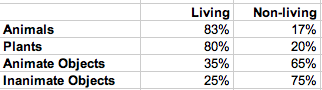
I broke it down a little further by categorizing these items as animals (cat), plants (tree, flower), animate objects (car, cloud, computer) and inanimate objects (ball, teddy bear, block):

Not surprisingly, animals (the cat) is the most obvious to Kg students of all the items, but I was impressed that plants followed so closely behind. Our Pre-K students do have a general plants and animals unit however, so perhaps that has some influence on this.

What’s most interesting to me is to notice which nonliving objects are misidentified the most: car, computer, cloud, and teddy bear are all misidentified by about 1/3 of the students! It’s pretty easy to understand why- 3 of them move and change, and 1 resembles a living thing.

Over the course of the unit, students learn about the characteristics of living things (they grow and change) and their needs. Students experiment by trying to grow seeds and blocks, also take care of a goldfish to learn about what it needs to live. In addition they play lots of sorting games to reinforce new ideas about what’s living and nonliving. How well does it work? Check out the post-assessment results:

Note: These results are missing one class that I haven’t received data from yet

Not too shabby. Granted this is not a very deep assessment (we have others for investigating students’ understanding in a more meaningful way), but for a quick check of factual knowledge this is good to see. It’s also useful to see what wasn’t learned as well, clouds appear to be especially confusing for some Kindergartners. Thinking about it, they do fit our characteristic of living things by growing and changing, and it’s difficult for students to investigate what clouds need or don’t need. So I’ll have to think more about this one- maybe the right approach would be a research investigation, posing the question Are clouds a living thing? and having students consult various resources (library books, websites, parent interviews) to collect “data” and then reach a conclusion as a class. Something for next year!

And that’s the wonderful thing about doing pre/post assessments (besides being a great example of learning for student portfolios)- it’s almost impossible to collect data like this and NOT have it influence and improve your teaching. So give it a try- I dare ya’!

Something’s been gnawing at me for awhile about standards-based grading (SBG). Sure, it’s far and above ye ‘ole traditional ABC grading which conflates effort and learning and spits out a mathematically precise but meaningless grade on a ridiculously large 100-point scale. But moving from ABC grading to standards-based grading isn’t easy- it demands change on all levels of education (teaching, assessing, and reporting) and change from all parties involved (students, teachers, and parents). Changing grading is a colossal cultural paradigm shift.

If your school is like mine, it’s a shift that seems to be stuck in some middle-ground grading purgatory. Yes we have standards, and yes we try to teach and assess to those standards. Where the shift seems to stall is with the reporting, which throws a wrench in the whole system. Here’s a typical struggle:

It’s the beginning of the trimester, and we’ve got our standards clearly defined for our unit. We have our assessments planned too, each carefully crafted to hit multiple standards in a meaningful way. And we’re off- teaching, learning, humming merrily along. The first assessment comes along and suddenly there’s a little confusion. What exactly do we mean by “meeting the standard”? “Exceeding the standard”? “Approaching the standard”? Never fear- we collected student exemplars last year, which we can show teachers and students so everyone knows what’s expected. But wait- the students are all trying to replicate the “Exceeding the standard” work, going for that 4, even though most of them need to show proficiency in the standard first before trying to reach above it. Then grades go home and parents are concerned when their students are “only” meeting the standard- that’s like a B right?? So we try to throw in some parent education at that point, to break their bad habit of translating 1s, 2s, 3s, and 4s into letter grades. Finally it’s report card time, and in practice our new standards-based report card turns out to be a lot more complicated than it seemed on paper. What if a student exceeded on this assessment but approached on this one? How detailed should we report out on? Why do these parents keep getting upset with 3s- didn’t we tell them it’s not the same thing as a B??

You get the idea. Like it or not, reporting will always make or break the system, especially in the hyper-competitive, accountability-crazed world we live in. Despite the merits of SBG, the challenges of reporting out standards-based grades (as I discussed here) is unescapable. Even my grading rebel hero who did away with points all together in favor of pure feedback is returning to a hybrid points/feedback system for the sake of efficiency. That’s the reality for both teachers and parents, in addition to the wonderful details, we also crave a simple way of conveying of how a student’s doing (I mean learning!).

So here’s the deal: because we can’t escape our need for a simple grade (letter, number, or otherwise), SBG in its present form falls short of the cultural paradigm shift it demands. Parents keep translating numbers into letters, students keep trying to exceed the standard to get the top grade, and teachers drive themselves crazy trying to agree on the meaning of it all. At the core of these tensions is a simple truth: everyone wants to be successful, but everyone is different, so success should not have the same definition for all. SBG is a huge step forward, but because it’s one-size-fits all it just doesn’t feel right, and our efforts continue to unravel.

How can we complete the shift? I think we need to reach a little farther. SBG shouldn’t stand for standards-based grading, but student-based grading. Instead of criterion-referenced, I believe assessment and grading should be self-referenced. Is this more challenging? Yes, but ultimately I think it’s this extra inch that will bridge the gap and move us to a new culture of learning and grading. Here’s why:

  • Differentiated: We go on and on in education about differentiation, but so far I think implementation of this has been only partial. For true differentiation it needs to take place at all educational levels (teaching, assessing, reporting)- and it’s last two where it usually falls short. If all students are going to be assessed and reported on the same standard, then by definition we aren’t differentiating. Student-based grading frees us to adapt to student’s individual learning needs, and reflects that differentiation all aspects of education.
  • Learning-focused: In their essence, report cards should communicate what students are learning (or not learning). With one-size-fits all standards, this may not be the case. If a student is way below or way above the standard, the report card isn’t going to be very informative at all. OK, they’re below the standard- but has the student made good learning gains this semester? Yay- they’re above the standard- but is the student continuing to learn or are they twiddling their thumbs? Student-based grading focuses assessment and reporting on the learning that’s actually taking place, whether it’s above, below, or at the standard.
  • Goodbye norm-referencing: Even though standards-based grading claims to be criterion-referenced, if you use points it’s really not. Students (and parents) will always pay more attention to the letter or number at the top than the standards or feedback below. Even if you get rid of these on assessments, for efficiency’s sake you’re going to use points of some sort on a report card- and then the norm comparison begins (Johnny got more 4s than Billy!). Student-based grading means the report cards are different for each student. Students are being graded on the standards and benchmarks that are appropriate learning goals for them. With individualized report cards like this comparing Johnny and Billy isn’t easy- but that’s the point- we shouldn’t be comparing them in the first place.
  • Keep it simple: After thinking a lot about grading and points, I keep gravitating back to the simplest solution: the binary method (pass/fail, meets/does not meet). It’s easy to understand and does not fall prey to our instinct to translate numbers into letters. The problem with using binary grading with standards-based grading is obvious: many students will be somewhere above or below the standard, so the grades are oversimplified and less informative. Student-based grading tailors the learning goal to fit the student, so a binary grade works much better- a more specific learning goal allows for a less specific grading system, and with less confusion.
  • Success for all: Parents can’t help but want to see As (or whatever your top grade is) on the report card. So if your grading system doesn’t make the top grade a realistic goal for students, you’re going to run into problems. Student-based grading adjusts the learning goals for students based on pre-assessment to give them realistic challenges. So students going for the top grade or parents expecting the top grade is no longer problematic, it’s exactly what they should be doing.

All set to sign up for the student-based grading movement? There’s only one problem… this is just an idea. Sure it sounds great on paper, but I’ve yet to put it into practice (so if anyone out there is doing something similar- I’d love to hear from you!) Moving from ABC norm-referenced grading to student-based grading would be a step further than standards-based grading, because in addition to all that SBG brings to the table, the reporting benchmarks and standards themselves would need to be differentiated. In order for appropriate learning goals to be selected for students, pre-assessment would need to be very well designed. And to top it all off, the report card system would need to be flexible enough to handle individualized report cards. All these challenges however, if met successfully, would do what standards-based grading seems to be currently failing to do: to once and for all shift our grading paradigm from a culture of competitive point gaming to a culture that values individual learning.

You know how you always think teaching is somehow going to get easier each year? I fell for that folly of an idea all over again this summer, thinking that because it’s my fourth year as science coordinator it would somehow be less work because I have it all planned out already. HA! Obviously I was forgetting that deep inside my soul resides a gnawing and persistant little bugger: Mr. Isn’t-there-a-better-way. And just when I thought I was getting set to cruise through the year, he had rear his ugly but inspirational head and get me off my metaphorical couch.

So here it is December and I find myself embroiled in several wonderful but seriously extracurricular projects that I’d love to blog about if I can  add a 25th hour to the day. Well, here’s on such project: The AERO Science Collaborative Workshop! Ok, I know it doesn’t roll off the tongue very well, so if anyone can come up with some sort of nifty acronym involving those words or similar, I’d be much obliged.

A little background: Project AERO is an educational arm of the U.S. State Department created to assist American schools abroad in implementing standards-based curricula. My school, along with most in the NESA region have adopted the AERO standards, in particular the K-8 science standards which were released two years ago. However, as international schools are by their nature isolated, we have very little opportunity to work together with each other and share what’s working with this standards-based shift. Yes, there are conferences set up by NESA and AERO which allow for some collaboration- but as with most conferences the focus is mostly on professional developments (aka listen to the expert at the front of the room).

So basically we’ve got several schools toiling with their heads down in the sand (quite literally in the Middle East), trying to complete this science curriculum overhaul with occasional  support from consultants here and there, but mostly going it alone. Which of course means a lot of work for everyone and not a lot of feedback or second-opinions on the best way to go about it. Why not get together and get our collaboration on?

This April we are attempting to do just that. With the help of my ASD colleagues and NESA science ed guru Erma Anderson, I’ve drafted a proposal to bring together K-8 science educators from five school (ASDubai, ACS Beirut, TASIM Oman, and ACS Amman) for three days of peace, love, and music…. whoops– wrong workshop– I mean three days of intense science curriculum collaboration. We’re hoping for around 20 teachers, with representation from lower elementary, upper elementary, and middle school. So far the response has been very favorable, and it seems I’m not the only one out there who sees the benefit in teachers teaching teachers for a change.

Now that my good idea is actually coming true though- I’ve got to figure out how to pull this off. So I’m eager to hear if anyone reading this has ever worked in such a collaborative cross-school setting before:

  1. What’s the best way to kick-start collaboration with a group of unfamiliar people?
  2. What organisation or set-up helped (or hindered) collaboration?
  3. What tools or technology did you use to facilitate collaborative work?
  4. What follow-up helped the collaboration continue after the workshop and build lasting collaborative relationships?

Here are some of my nascent thoughts on these matters:

  1. I’m thinking of starting with something called “Share Your Strengths” where each school briefly presents some of the curriculum work they’ve done that they think is good stuff. This will not only get our best ideas out there quickly, it should also give us a chance to build a little rapport and trust so we respect each other’s opinion when we dive into collaborative work.
  2. In my experience small group work (about 3 people) seems to be the most productive. You get a variety of opinions but don’t get weighed down by too many. So depending on numbers I’m thinking of breaking us up into teams of similar grade-level and possibly subject interest (so for example, a team of MS teachers working on a physical science unit). I don’t want to over-structure the workshop since I want it to be tailored to school’s needs, so the goal for each team’s work may even be left up to them.
  3. I really want to make sure the work that’s done is easily accessible to all after the workshop, and that whatever platform we use encourages further long-distance collaboration. I’m very familiar with GoogleDocs and GoogleSites, so I’m leaning that way. We also may have some teachers attending virtually, so we’ll need to figure out how to accommodate that (maybe Skype them in for certain parts?)
  4. I know how it is after a conference. You have all this stuff you’re excited about, but then you slip back into your daily grind and never get around to all those good ideas you had. I know 3 days isn’t much time to build “lasting collaborative relationships”, but I’d like to try to nurture the collaboration to the point where it’s self-sustaining. I’ve been blown away by the high level of collaboration going on in the blogosphere, so maybe I’ll even try to turn teachers on to that. The secret ingredient seems to be that blend of the personal and the professional- both intellectually and relationally stimulating.

and no teacher hears it, what’s the point of putting together the workshop in the first place?

Or at least that’s how I felt last week when a grand total of 1 teacher showed up for my after school PLOT (Professional Learning Opportunities for Teachers) workshop about revising the scientific method. But even if the workshop didn’t happen quite as I had imagined it- with lively dialogue and moments of hands-on discovery- at least I can share it here, on the blog I’ve been neglecting so badly the past month. Here’s how the Scientific Method Makeover workshop was supposed to go down…

I’ve already detailed my thoughts behind revising and updating the tired and unrealistic scientific method on this post, so I won’t repeat myself here. Suffice it to say that the scientific method we learned as kids needs a makeover, but I do believe in teaching the process of science- as long as it’s flexible enough to incorporate the different ways scientists actually learn. My attempt at improvement is the scientific cycle:

How does this cycle work? Let’s put it into action and find out! Since it’s getting a little cold these days in Qatar (down into the 60s at night- brrrr!) everyone’s probably wondering where they stashed their portable electric heaters (buildings in Qatar don’t have centralized heat for obvious reasons). But how does an electric heater really work? We have your question– Boom! The scientific cycle commences, this time for a bout of secondary-source learning, aka research. Before diving into Google, I have teachers take a step back in the cycle and try to pre-explain how an electric heater works. Getting those preconceptions out there is important to encourage further questions and critical thought about any misconceptions that might exists. Got a vague and probably incorrect notion of how they work?? Great- back to Google, let’s investigate.

I give teachers a few guiding research questions to investigate on their own, then and there on their laptops:

  • How do electric heaters work?
  • What are electric heaters made of? (in particular the heating element)
  • How does electrical energy turn into heat energy?

Now everyone’s research and comprehension will be a little different, so to analyze their research findings I have teachers share and compare in small groups for a few minutes. Really, they’re a doing a synthesis of their research- compiling information from different sources and reconciling any discrepancies, which in turn gives them a better understanding of the “data”, in this case their research.

To explain I have them draw and label a picture explaining how an electric heater works. Better understanding than your pre-explanation? You betcha. In a nutshell, that was a much-simplified scientific round of research. It’s important to note that it might not be such a clean flowing cycle though- new questions could come up and cause a scientist to go back and re-investigate, or compare findings with someone else to re-analyze. But the general process is there: question-investigate-analyze-explain.

But wait- what about experimentation and all that? Let’s do another round of the cycle, but this time it’s hands-on. How do scientists answer a question when there’s nothing in the research to help? Let’s do an experimental cycle…

I show the teachers how a coil of wire attached to a D-cell battery creates a very simple electric heater (similar to the electromagnet circuit at right, except no nail necessary, wrap around a thermometer bulb instead). Technically it’s a short circuit, so the current is trying to race through, only slowed by the resistance in the wire, which generates heat. Hmmm… I wonder if it matters what kind of wire we use- some are thicker, some are thinner. Which wire would make the best heater? As before, let’s make a prediction, our pre-explanation, which we will revisit and revise later. And we’re off, investigating by having teachers creating a quick controlled experiment, something to the tune of comparing the different thicknesses of wire (but same length) in identical circuits, and wrapping the coils around thermometers to measure the temperature increase.

After 60 seconds of heating we’ve got some data, let’s analyze: in this case we can use mathematics to add different groups of teachers’ data together and find the mean for each thickness of wire. This has the same effect of doing repeated trials for accuracy (as long as we did a decent job controlling variables). A few calculations, and what do we find…. Try it yourself! Sorry, the elementary teacher in me just can’t spoil the excitement of discovery for you. Just try it out- I was excited myself to discover the difference, especially when it started to make sense, which brings us to…

Explain by writing a conclusion statement, supporting your claim with evidence. And there you have it, two complete tours of the scientific cycle in under an hour, with hopefully a demonstration of how versatile and useful the scientific cycle is as a new-and-improved scientific method. Whether you’re doing research-based investigations or experimental ones, the same general process applies. So the cycle is a framework, reminding students of the importance of making predictions (pre-explain), critical thinking (analyze) and meaning-making (explain). It also serves as a reminder of the cyclical process of scientific learning, as one question leads to another. The scientific skills at each step can vary, and with practice students could even learn to decide which skill would be appropriate to use as the learning demands.

End scene. I’m still wondering how this workshop would actually fly in real life, but in the meantime I’d be satisfied with any thoughts or comments you have (especially if you try your own electric heater experiment!).


Back from the dead

It’s the day after Halloween, so it’s pretty fitting that today I’m coming back from the dead and finally blogging again! The past few weeks have been crazy for me, as I attended not one but two international science ed conferences which had me jet-setting around to Athens and Barcelona (don’t you feel sorry for us international educators??).

My travels (and subsequent opportunities to do some reading) has left my mind buzzing with new ideas- I’ve probably got enough material to post for the rest of the year. So here’s a little teaser of some things to come:

  • Nuggets of wisdom from Dr. Fran Prolman’s outstanding teacher leadership institute including strategies for building effective teacher teams and how to deal with “difficult conversations” with parents or other teacher
  • Thoughts on how to reinvigorate the tired elementary science fair, including a new online student manual that I’m creating for the NESA Virtual Science Fair which my school is involved with
  • Reflections on progressive education and radical school reform after reading Alfie Kohn’s The Schools Our Children Deserve
  • Forecasting the future of textbooks after being inspired by Al Gore’s iPad app e-book thingamajiggy Our Choice 
  • And finally wrapping up the discussion of pre and post assessments, with some statistics for dummies
Great- now I’ve got a nice long to-do list for myself. Stay tuned!

A few years ago I attended a  presentation at my school called “Thinking about Knowledge” by Martin Skelton, and one brief comment he made really changed my whole outlook on assessment and reporting. He simply said “true assessment must be pre and post”. In other words, how can you claim to assess learning and report on learning if you don’t know what students know beforehand?

This set me off on a tangent thinking about the future of report cards. Sure everyone’s on the standards-based bandwagon now (including myself), but wouldn’t report cards be even better if they were student-based, that is they report the actual growth of the student’s learning, not just a final snapshot of how they measure up to some arbitrary standard? I understand that have some benchmarks for evaluating one’s progress compared to the “normal” expectation is important, but I think the evolution of learning is trending towards even more personalized learning and assessment, and soon we should be able to track and report on learning in a truly student-based way.

Anyways, I digress! The point I’m trying to make is that teachers need to do a better job of pre-assessing their students. While some may think pre-assessment is a waste of time, the opportunities they give for personalized differentiation and assessment of learning progress are many and valuable: Pre-assessing allows you to identify the students who already have a grasp of certain concepts and will need to be challenged in other ways to continue learning. Pre-assessing exposes student misconceptions that may interfere with learning and need to be addressed. Most importantly pre-assessing gives the teacher and the student a clear“before and after picture” of their learning, which is useful for student reflections, parent conferences, and teacher improvement as well.

For the past few years we’ve been doing pre and post assessments for all of our science units K through 5. It’s taken a lot of trial and error to refine them, but we’ve improved them to the point where they are useful and important piece of our curriculum, so I’d like to share the product and the process. Since it gets a little technical (and it’s getting a little late for a sleep-deprived new parent like me), I’ll break this up into a two-part post: the pre post and the post post.

I’ll use our 3rd grade Sound and Light unit as the example, since I can share some of the pre and post data that’s already come in this year (if you’d like to see examples from other grades- just let me know). Here’s the Sound and Light  pre-assessment, a short written assessment with 6 short-response questions:

The questions have been developed carefully to get a bit of assessment evidence for each of the key concepts of the unit. The post-assessment, as you will see, is much more thorough, but I believe efficiency trumps thoroughness for pre-assessments, so we’ve kept our pre-assessments short and sweet. Also, all of our pre-assessment questions are open-ended/free response, since we don’t want to encourage any guessing with multiple-choice type questions, we want the pre-assessment to be as true a reflection of students’ prior knowledge as possible.

I should add that the pre-assessment is given to students at the very beginning of the unit, with basically no prompting other that “I’d like to find out what you already know about sound and light. If you aren’t sure of something, it’s fine to just write ‘I don’t know.'” Students unfamiliar with pre-assessments will need reassurance that it’s not graded as well!

Teachers don’t need to spend time rigorously assessing these pre-assessments, they simply give them a look over to help them identify the students who already have a lot of prior knowledge about the subject and will need their learning differentiated. We have a pretty high-achieving student body, so there’s always a few in each class who need this kind of extra challenge (side note: I once had a 1st grader identify on a pre-assessment the scientific name and function of each of a fish’s fins! Good luck differentiating that one!).

Then pre-assessments are passed on to me. As the science coordinator at my elementary school, I use the pre and post assessments to evaluate the success of the unit. So take a random sample of 5 students from each class (random.org is a great site for generating quick random number sequences for this) and score their pre-assessments. Like all of our assessments there’s a 4-point standards-based rubric for this. A 3 is meeting the standard, a 2 is approaching, a 1 does not meet, and a 4 is exceeding or excelling. Here’s the scoring guide for the pre-assessment:

I record all of these scores into a spreadsheet, because I want to be able to compare the scores of the same students on the post-assessment after the unit. This year I’ve been using GoogleDocs for my spreadsheets, because it’s great for sharing the results with teachers easily and without cluttering up their inboxes. Here’s a snapshot of what the spreadsheet for this pre-assessment looks like:

As you can see, besides the 4-point scores, I also like to pick one question and record their responses. There’s always some interesting prior conceptions that pop up… for instance you can see here some students are already making connections about sound and air, and sound bouncing off things, and a couple of the students are already aware that sound in made from vibrations (differentiation anyone??).

Lastly the pre-assessments are saved so students can look at them again after the post-assessment at the end of the unit. But more on this later in the post post… stay tuned!

The other night I gave a presentation to parents about our elementary school science curriculum. Since it summarizes both our program at ASD and some of my own philosophy about science teaching, I though I would share it here.

As John mentioned, it’s ironic to lecture parents about inquiry learning, but I’ve yet to come up with a better idea short of installing Big Brother cameras in my classroom or holding a “Bring Your Parent to School” day… so I’d love to hear other approaches on this.
